By Dr. Pamela Frank, BSc(Hons), Naturopath
What is Basal Body Temperature?
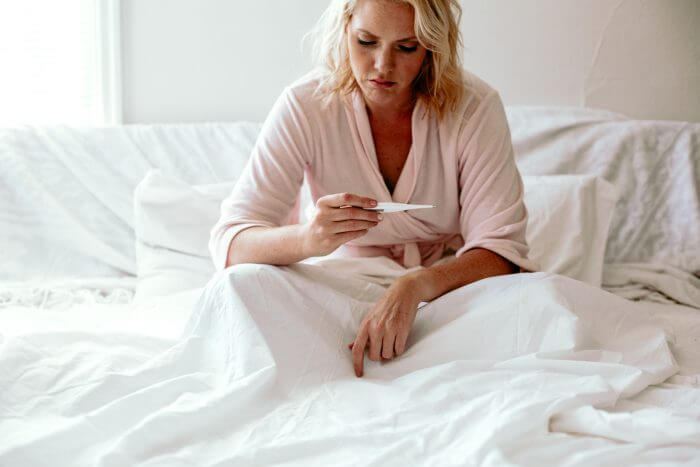
Basal Body Temperature, or BBT, is your resting body temperature. It is usually checked when you open your eyes in the morning. It is best taken before you get up or move around overly much. Your thermometer should be on your night table, right beside your bed, so you don’t have to get up to go and get it. You pop it under your tongue, ear, or arm first thing each morning. Aim to check your BBT at about the same time each day, 7 days per week. You want to check your BBT throughout your entire cycle, ideally for 2 or 3 cycles. Basal body temperature should also be checked after at least 4 hours of consistent sleep.
What is the purpose of checking BBT?
As a naturopath, I will ask many female patients to check their BBT. We can gather a wealth of information from this.
- Are you ovulating? Despite common misconceptions, having a regular period does not guarantee that you are ovulating. Even having a positive ovulation predictor kit test (OPK) does not guarantee that ovulation is occurring. The OPK tells you that your body is TRYING to ovulate but does not confirm successful ovulation. BBT confirms whether ovulation was successful.
- When are you ovulating? To try to conceive, knowing when you ovulate from your BBT will help you to time intercourse for the days when conception will be most likely to be successful. The optimal timing for intercourse is 24-72 hours before ovulation.
- Once you do ovulate, is your progesterone production healthy? The increase in progesterone following ovulation increases your body temperature post-ovulation. What we like to see on a BBT chart is a fairly abrupt rise after ovulation and then a relatively stable temperature until just before your period is going to come. BBT charting has advantages over blood testing for this purpose. It gives us a broad overview of your progesterone production throughout the portion of your cycle after ovulation, also known as the luteal phase. Healthy and consistent progesterone production is vital for embryo implantation and maintenance of the pregnancy. Women who struggle with infertility often have suboptimal progesterone production throughout their luteal phase. Even in women who are not trying to conceive, healthy, consistent progesterone production prevents menstrual cramps, relieves anxiety, maintains healthy bone density, and relieves conditions like endometriosis, polyps, and fibroids.
Once you have collected your BBT readings, you want to input them into an app that will transform the BBT numbers into a graph. The graph makes it easy to distinguish the patterns that indicate ovulation and subsequent progesterone production. The apps that I commonly recommend to patients include Kindara and Fertility Friend. However, if you have a favourite period tracker app already installed on your phone, it likely has a BBT function built into it.
Book Now
Dr. Pamela Frank has been in practice as a naturopathic doctor for over 26 years. Since 1999, she has earned acclaim as a leading naturopath in Toronto, amassing multiple awards.
Dr. Pamela has a special interest in addressing hormone-related complexities, including but not limited to PCOS, endometriosis, acne, hair loss, weight management, thyroid issues, and fertility.
Residing in Toronto with her family and loyal companion, Dolly the rescue dog, Dr. Pamela seamlessly combines her professional commitment with a diverse range of interests.
Beyond her clinical endeavours, she actively engages in kickboxing, leadership roles within Scout Groups, yoga practice, podcasting, and outdoor pursuits such as backcountry camping.
Dr. Pamela’s comprehensive approach reflects not only her dedication to optimal health but also her passion for continual personal and professional growth.
